


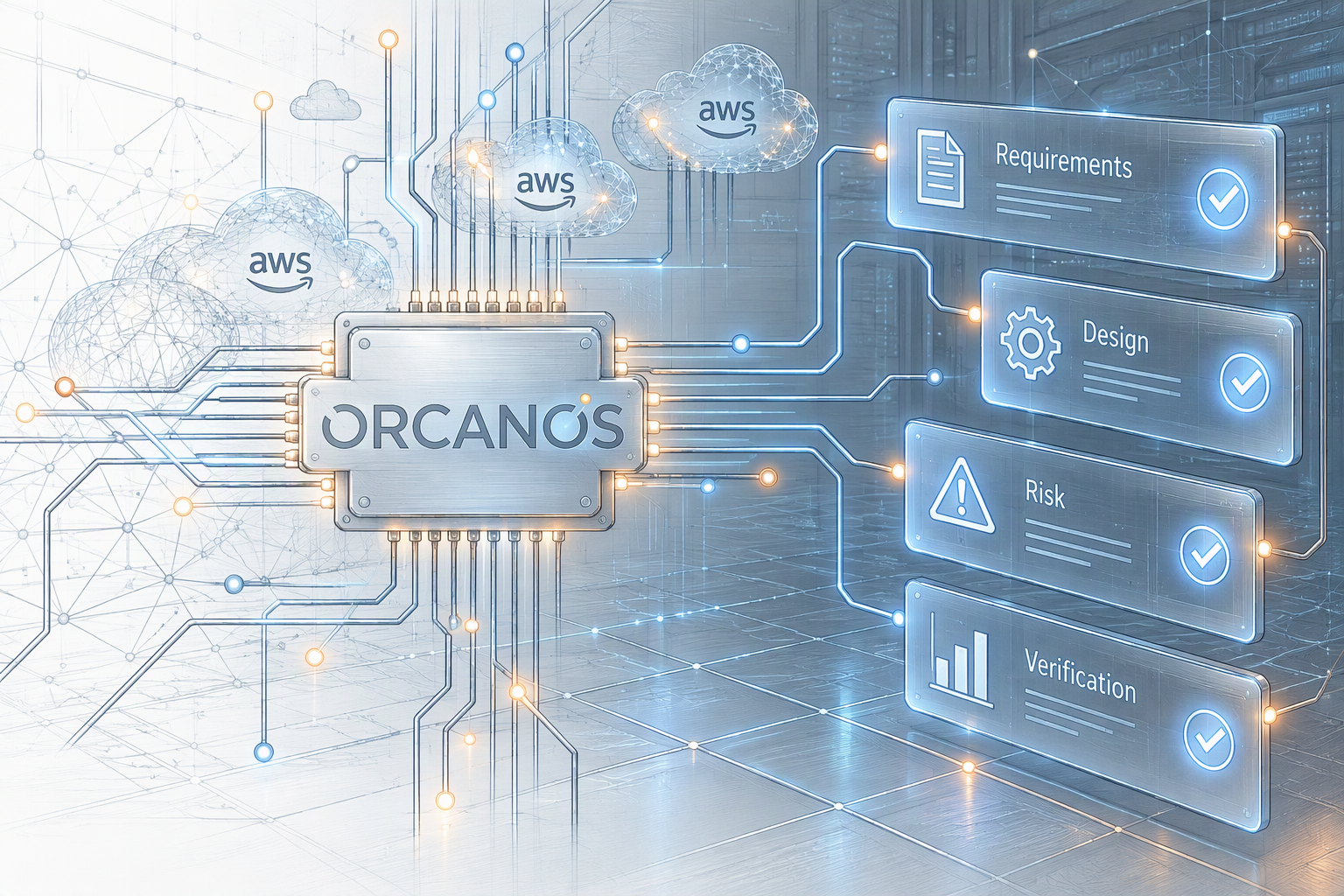
The Division of Labor: Orcanos, Amazon Bedrock, and AWS
AI-assisted analysis brings three layers together:
- Orcanos provides structured engineering knowledge. Requirements, risks, CAPAs, change requests, tests, and other objects are maintained in a relational database with their relationships, status, and versions.
- Amazon Bedrock provides the AI processing platform. The Orcanos integration can supply selected information from the relational database. Bedrock provides access to supported language models and controls for inputs and outputs.
- AWS provides the underlying infrastructure. This includes compute, storage, and networking, along with identity and access management, encryption, network isolation, and logging.
The value lies in how these layers work together. AI does not first have to reconstruct relationships among requirements, risks, and tests across unstructured documents. Orcanos can supply that documented structure. The relevant question becomes: what can the relational data model establish reliably, and where does AI add value?
Why the Relational Data Model Matters
From isolated information to connected engineering knowledge
Product knowledge is more than a collection of requirements, risks, or test cases. Relationships often matter most: Which risk gives rise to a requirement? Which control mitigates the risk? Which requirement specifies that control? Which test demonstrates its implementation?
A relational database can represent such causal chains explicitly. When rationales are captured as well, the reasons behind a solution remain visible. Assumptions, trade-offs, and rejected alternatives stay available when decisions must be reassessed, or the people originally involved are no longer available.
What database rules can verify reliably
This foundation makes formal questions answerable in a deterministic way. Do the objects under review have the required status? Is a test case assigned to the requirement? Is a documented mitigation linked to the risk? Documented relationships and defined rules can also identify which additional objects must be included in a change review.
A relationship alone does not answer every technical question. A link between a requirement and a test case does not establish whether the test still covers the requirement’s intended meaning after a change. The database provides the documented structure. Interpreting its technical significance requires context. That is where AI-assisted analysis begins.
A practical example: Change of Requirement
A product function must detect a critical condition more quickly, so the maximum allowable response time is reduced. The relational data model shows the documented chain:
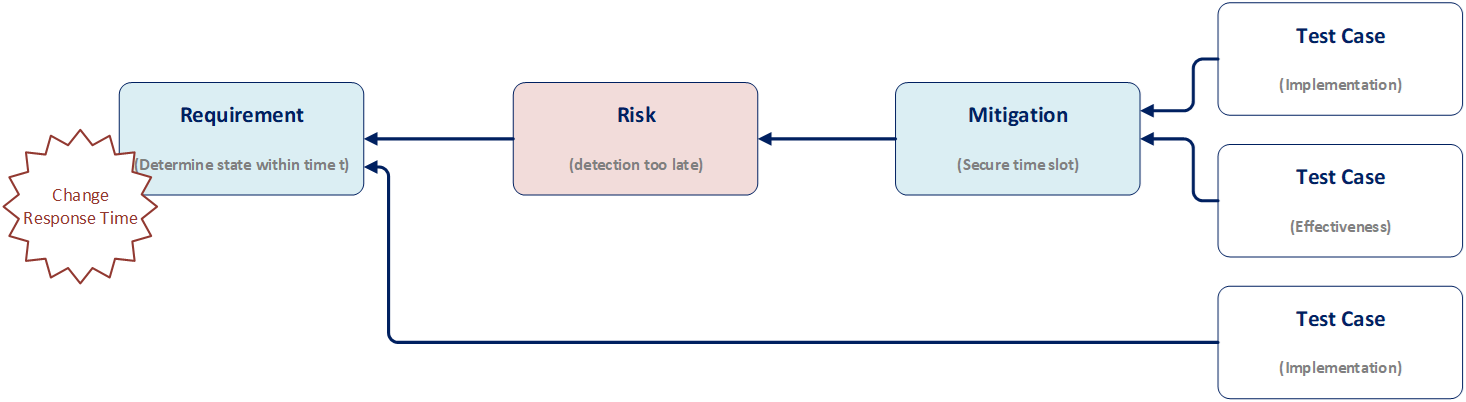
Figure 1: Causal Chain of Data Elements affected by Change Request
The rationale explains that the previous threshold was selected to detect critical conditions in time without treating short-lived signal spikes as alarms. The decision reflected a trade-off between detection speed and false-alarm prevention. Changing the threshold makes that trade-off relevant again. Without the rationale, the team would know what changed. With it, the team also sees which assumption must be reassessed.
AI analysis: What does the change mean technically?
The changed requirement, linked risk control, rationale, and existing test conditions can be supplied to AI. This can surface specific review questions:
- Does the existing test verify only response speed, or also behavior during short-lived signal spikes?
- Does the original protection against false alarms still hold under the tighter threshold?
- Do the supplied architecture materials contain comparable detection functions whose rationales or tests matter to the assessment?
Keeping AI Output Under Control
Relationships, versions, status, and defined formal requirements can be checked through rules. AI is used where content, reasoning, and contextual meaning must be examined. The reach of formal checks depends on data granularity, data quality, and implemented rules.
Findings restate verifiable information from the supplied data and should point to the relevant sources and versions. If a discrepancy can be detected through rules, the database should identify it.
Interpretations place documented findings in technical context. Their reasoning must remain traceable to the supplied information.
Hypotheses describe possible effects that have not yet been demonstrated. They are useful lines of inquiry, not confirmed effects or demonstrated risks.
Findings are verified, interpretations are assessed by experts, and hypotheses are investigated. AI therefore does not become a new layer of truth above the engineering data. It adds an analytical layer whose output must remain reviewable.
Provide Only the Context the Analysis Needs
A specific analysis does not necessarily require the entire product documentation set. The changed requirement, linked risks and controls, relevant rationale, and associated test conditions may provide the necessary starting context. Architecture information can be added where the question requires it.
Targeted selection keeps irrelevant information out of the analysis context, while the team must ensure that nothing required for a sound assessment is missing. This does not replace privacy or security controls. It does make the intended context explicit and reviewable. The relational data model therefore leads directly to the security question: what happens to the selected product knowledge once it is submitted for AI processing?
Amazon Bedrock: Introducing AI Processing with Control
Amazon Bedrock provides access to supported large language models and capabilities for governing their use. The question is not only which model is appropriate, but how inputs and outputs are controlled. [3][4]
Guardrails: Rules for inputs and outputs
Amazon Bedrock Guardrails can evaluate prompts and responses against configured policies, for example by blocking unwanted topics or masking detected personal information. The same rules can be applied across models. Contextual grounding checks can assess whether a response is supported by the supplied reference material. These controls do not establish that an engineering decision is technically correct; expert review remains necessary. [13][14]
Using different models without changing the data foundation
Amazon Bedrock provides access to multiple supported LLMs, including models from Amazon and Anthropic. For supported models, the Converse API provides a consistent interface. Models can therefore be compared or changed without altering the relational data structure in Orcanos. A model change still requires prompts, parameters, and output quality to be reassessed. Actual availability depends on model, region, and the Orcanos integration. [3][4][5]
Data Security: What Happens to Product Knowledge?
Requirements, risks, and rationales may contain confidential development and product knowledge. Data security therefore depends on training use, retention, access, network path, and processing location. Amazon Bedrock and AWS provide mechanisms that can address these requirements. The decisive question is which capabilities are implemented and contractually committed for the specific Orcanos AI function.
Are my data used for model training?
According to AWS, Amazon Bedrock inputs and outputs are not used to train Amazon or third-party models. Processing a request is distinct from incorporating product knowledge into model training. [6]
Not used for training does not automatically mean not retained. Depending on the model and settings, content may be retained for abuse detection. Amazon Bedrock also supports scenarios with no persistent retention of prompts and responses, referred to as Zero Data Retention. Users therefore need to establish the retention terms for the specific AI capability and whether responses or logs are stored elsewhere. [10]
Who can access my information?
AWS describes encryption for data at rest and in transit, while access controls restrict who can use the data. Existing authorization boundaries must also hold when AI is introduced: anyone who may not view particular product information should not be able to obtain it through an AI response. Stored analysis results require protection appropriate to their source information. Context selection, AI output, and retained logs all belong within the security model. [6][7]
Which network path carries the data?
AWS PrivateLink can connect a VPC privately to Amazon Bedrock without routing traffic over the public internet. Along this path, transmitted information remains on the AWS network. The technical product documentation should confirm whether the offered Orcanos function uses this connectivity. PrivateLink does not replace the assessment of access, retention, authorization, or processing location. [8]
Can processing remain within the EU?
The location of the Orcanos database does not answer this question on its own. The processing location of the language model must also be considered. Amazon Bedrock can route requests within a defined geography, such as the EU, or across globally available locations. The option depends on the model and inference profile. If processing exclusively within Europe is mandatory, the required configuration must be agreed and demonstrable. The same requirement remains relevant after a model change. [5][15]
What does the AWS European Sovereign Cloud add?
The AWS European Sovereign Cloud provides an additional option for organizations with heightened requirements for European data residency and EU-controlled operations. According to AWS, its first region is in Brandenburg and its infrastructure is physically and logically separate from other AWS Regions. Whether the required Orcanos AI capability is offered there must be confirmed. The “Sovereign Cloud” label does not replace that verification or the organization’s own security and privacy assessment. [11]
AWS and Amazon Bedrock provide mechanisms that can address core concerns about training use, retention, access, network path, and processing location. A defensible assessment depends on demonstrating that the relevant mechanisms are actually used in the specific Orcanos configuration.
Will It Be Expensive?
Looking only at the price of a single model call is too narrow. For text-based models, cost depends on the model, input volume, response length, number of analyses, and additional capabilities such as Guardrails. A model change can affect both quality and cost. Published AWS pricing does not automatically equal the price of the Orcanos AI function. Prospective customers need the terms of the actual offer. [9]
Structured data can limit processing effort
If the relevant requirements, risks, controls, rationales, and test conditions can be assembled specifically for the analysis, the entire documentation set may not need to be processed. Less irrelevant context can reduce processing effort, provided all information required for the assessment remains included.
Evaluate total value, not model cost in isolation
Time savings: Relevant information, prior decisions, and associated test conditions can be assembled more directly for technical review.
Earlier problem detection: Contradictions, inadequate test coverage, or assumptions that may no longer hold can become visible before approval.
⠀
Less rework: Problems identified before further development, testing, or documentation builds on them may avoid later change effort.
Fewer field issues: If relevant weaknesses are identified and resolved early, later remediation, service activity, or customer complaints may be avoided. This is a potential benefit, not a saving that can be assumed by default.
The economic question is not simply what a model call costs. It is whether time savings, earlier problem detection, and avoided rework justify the total effort for AI use, data maintenance, preparation, and review.
Use a Bounded Pilot to Produce Defensible Results
A manageable pilot can focus on one product area, a small user group, and a few representative requirement changes. The team defines the objects and relationships required, the applicable versions and status values, and the relevant rationales. Authorization and agreed privacy conditions form the binding framework.
Start with the data layer
- Are the correct causal chains selected?
- Are the relevant versions and status values included?
- Are the necessary rationales available?
- Do formal checks produce reproducible results?
- Is any information missing that the technical interpretation requires?
Then evaluate AI analysis, security, and economics
AI requests are tested with a clear task, bounded context, and source references. Expert-reviewed comparison cases show whether the analysis captures relevant information, interprets relationships appropriately, and distinguishes findings, interpretations, and hypotheses. The evaluation must also cover missed relationships, misinterpretations, review effort, source traceability, and incomplete context.
The pilot should confirm the models and processing regions used, retention of inputs and outputs, access rights, network path, and any resulting logs. It should compare confirmed findings, missed issues, misinterpretations, time savings, review effort, and usage cost. Proven queries, prompts, and model settings can then form a tested baseline. Expansion becomes appropriate only when data queries and AI requests produce defensible results and the agreed safeguards are in place.
Conclusion: Put Structured Knowledge to Work with AI
The value of Orcanos AI comes from combining structured data with context-aware analysis. Documented relationships show which engineering objects belong together. Rationales reveal the assumptions and trade-offs behind earlier decisions. AI can examine that deliberately selected context and develop technical review questions, interpretations, and hypotheses. Formal checks remain in the database layer, and the responsible team retains the technical decision.
Amazon Bedrock provides access to different language models and controls for AI processing. AWS adds infrastructure and security mechanisms. These capabilities can address questions about training use, retention, access, network path, and processing location with appropriate precision. What matters is not only what AWS makes possible in principle, but what the specific Orcanos solution implements technically and commits to contractually.
A bounded pilot brings these layers together. It shows whether the data model supplies the right context, AI produces technically useful output, security requirements are met, and added value justifies total effort. On that basis, use can expand in a controlled, stepwise manner.
FAQ for Readers and Decision-Makers
The following FAQs provide concise answers to the article’s key questions. They explain how structured data and AI analysis work together and highlight the main considerations for control, security, and practical use.
What is the difference between database checks and AI analysis?
Database rules verify documented relationships, status, versions, and formal requirements reproducibly. AI examines content, reasoning, and potential technical effects in context. A link between a requirement and a test case shows that they belong together. Determining whether the test still covers the changed technical intent requires additional analysis.
Why do documented rationales matter for AI analysis?
Rationales preserve the assumptions and trade-offs behind earlier decisions. When a requirement changes, they show not only what is affected, but which prior reasoning should be reassessed. This keeps decision knowledge available across projects and personnel changes.
Does an AI analysis require the entire product documentation set?
Not necessarily. A specific analysis may need only the changed requirement, linked risks and controls, the relevant rationale, and the associated test conditions. Additional information is included when the question requires it. Targeted context selection does not replace security controls, but it limits irrelevant material and makes technical review easier.
How can AI output remain under technical control?
AI output is classified as a finding, interpretation, or hypothesis. Findings restate verifiable information. Interpretations place that information in technical context. Hypotheses identify possible effects that still need investigation. Findings are verified, interpretations are assessed by experts, and hypotheses are tested deliberately.
Does AI decide whether requirements, tests, or risk assessments must change?
No. AI can surface review questions, interpretations, and hypotheses. The responsible team decides whether additional tests, different controls, or a revised risk assessment are required after expert review.
What roles do Orcanos, Amazon Bedrock, and AWS play?
Orcanos provides structured engineering knowledge with documented relationships, status, and versions. Amazon Bedrock provides access to supported language models and controls for AI processing. AWS supplies the underlying compute, storage, and network infrastructure, along with security capabilities.
Are Amazon Bedrock inputs and outputs used for model training?
According to AWS, Amazon Bedrock inputs and outputs are not used to train Amazon or third-party models. Retention is a separate question. Not used for training does not automatically mean not retained. The applicable retention terms must therefore be established for the specific offering.
How are access and network connectivity controlled?
Existing authorization boundaries should extend to context selection, AI output, and retained logs. Anyone who may not view particular product information should not be able to obtain it through an AI response. AWS PrivateLink can provide private connectivity to Amazon Bedrock. The technical product information must confirm whether the specific Orcanos configuration uses it.
Can processing be restricted to Europe?
The location of the Orcanos database alone is not sufficient. The processing location of the language model must also be considered. If processing exclusively within Europe is mandatory, the required configuration must be agreed and demonstrable. That commitment remains relevant when the model changes.
Which security conditions must be confirmed for the specific Orcanos configuration?
The organization should confirm the models and processing regions used, retention of inputs and outputs, access rights, network path, and any logs created. The fact that AWS offers a capability does not establish that the specific Orcanos AI function uses it.
What determines cost and economic value?
Cost depends on the model, input volume, response length, number of analyses, and additional capabilities such as Guardrails. AWS pricing does not automatically equal the price of the Orcanos AI function. Economic value depends on whether time savings, earlier problem detection, and avoided rework justify the effort for AI use, data maintenance, preparation, and review.
How should an Orcanos AI pilot be structured and evaluated?
A bounded pilot focuses on one product area, a small user group, and a few representative changes. It first checks causal chains, versions, status, rationales, and formal rules. It then evaluates AI output quality, missed relationships, misinterpretations, review effort, security conditions, and usage cost. Expansion should follow only when data queries and AI requests produce defensible results and agreed safeguards are in place.
Sources and Publication Notes
Current as of October 2026. Product and platform statements are based on publications from Orcanos and AWS. The examples illustrate potential uses and do not demonstrate results for individual customers. Available capabilities and safeguards depend on the Orcanos configuration and selected models and services. AI output requires expert review. This article does not substitute for a complete analysis or for assessing suitability in a specific regulated use case.
[1] Orcanos, “eQMS & ALM Software for Medical Devices.” https://www.orcanos.com/
[2] Orcanos, “Traceability Tool: Streamlines Traceability Management.” https://www.orcanos.com/requirements-traceability-tool
[3] AWS, “Overview – Amazon Bedrock.” https://docs.aws.amazon.com/bedrock/latest/userguide/what-is-bedrock.html
[4] AWS, “Model availability & compatibility – Amazon Bedrock.” https://docs.aws.amazon.com/bedrock/latest/userguide/models.html
[5] AWS, “Model support by AWS Region in Amazon Bedrock.” https://docs.aws.amazon.com/bedrock/latest/userguide/models-regions.html
[6] AWS, “Security, privacy, and responsible AI – Amazon Bedrock.” https://aws.amazon.com/bedrock/security-privacy-responsible-ai/
[7] AWS, “Data protection – Amazon Bedrock.” https://docs.aws.amazon.com/bedrock/latest/userguide/data-protection.html
[8] AWS, “Use interface VPC endpoints (AWS PrivateLink) to create a private connection between your VPC and Amazon Bedrock.” https://docs.aws.amazon.com/bedrock/latest/userguide/vpc-interface-endpoints.html
[9] AWS, “Amazon Bedrock Pricing.” https://aws.amazon.com/bedrock/pricing/
[10] AWS, “Data retention – Amazon Bedrock.” https://docs.aws.amazon.com/bedrock/latest/userguide/data-retention.html
[11] AWS, “European Digital Sovereignty.” https://aws.amazon.com/compliance/europe-digital-sovereignty/
[12] AWS Security Blog, “Run open weight models on Amazon Bedrock in AWS European Sovereign Cloud,” September 17, 2026. https://aws.amazon.com/blogs/security/run-open-weight-models-on-amazon-bedrock-in-aws-european-sovereign-cloud/
[13] AWS, “Detect and filter harmful content by using Amazon Bedrock Guardrails.” https://docs.aws.amazon.com/bedrock/latest/userguide/guardrails.html
[14] AWS, “Use contextual grounding check to filter hallucinations in responses.” https://docs.aws.amazon.com/bedrock/latest/userguide/guardrails-contextual-grounding-check.html
[15] AWS, “Route model inference requests across AWS Regions with cross-Region inference.” https://docs.aws.amazon.com/bedrock/latest/userguide/cross-region-inference.html